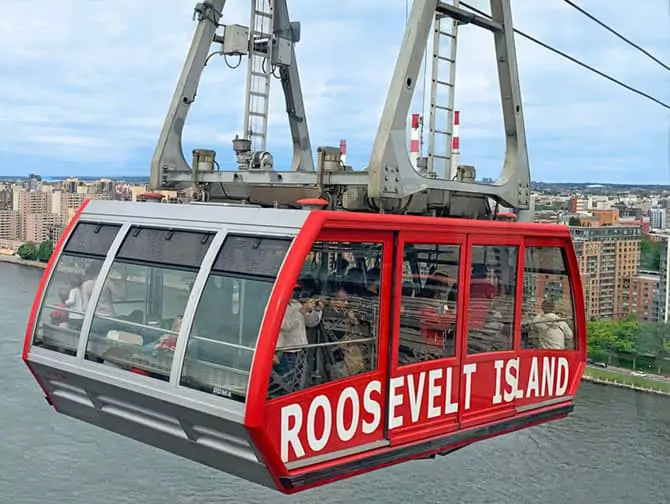
Image source: NewYork.co.uk
Quick Answer: As of 2026, the Roosevelt Island Tram operates from 6:00 AM to 2:00 AM (Sunday–Thursday) and 6:00 AM to 3:30 AM (Friday–Saturday).
The fare is $2.90 each way. You can pay by tapping your phone or credit card at the OMNY readers, or by swiping a standard MTA MetroCard. The tram departs every 7.5 minutes during rush hour and every 15 minutes during off-peak times.
Suspended 250 feet above the East River, the Roosevelt Island Tramway is widely regarded as one of the most scenic transit routes in New York City. While thousands of tourists flock to the bright red cabins for panoramic views of the Manhattan skyline, the system remains a vital, everyday commuter lifeline for the island's residents.
Because it operates slightly differently than the standard MTA subway system, understanding the exact Roosevelt Island Tram schedule, payment methods, and boarding rules is essential to avoid being stranded or caught in massive tourist queues. This comprehensive guide covers everything you need to know to navigate the tram efficiently in 2026.
Unlike the New York City Subway system, which operates 24 hours a day, the Roosevelt Island Tram has specific opening and closing hours. Missing the final tram of the night means you will need to rely on the F train subway line or take a significantly longer taxi ride across the Roosevelt Island Bridge from Queens.
The standard operating schedule is highly consistent throughout the year:
The system powers on promptly at 6:00 AM every day. The first hour of operation is typically quiet, primarily serving hospital workers, early-shift employees, and residents heading into Manhattan. By 7:00 AM, the morning rush begins, and the cabins fill up quickly with daily commuters. If you are riding for leisure or photography, it is highly recommended to avoid the 7:30 AM to 9:00 AM window, as priority is naturally given to residents trying to reach their workplaces.
The extended weekend hours (closing at 3:30 AM on Friday and Saturday nights) are designed to accommodate residents returning from Manhattan's nightlife. During these late-night hours, the tram operates on a reduced frequency. It is important to note that the doors to the boarding platform are locked promptly at closing time. If you arrive at the Tramway Plaza at 2:01 AM on a Tuesday, you will not be able to board.
The tram typically maintains its standard operating hours on major holidays, including Thanksgiving, Christmas, and New Year's Day. However, the Roosevelt Island Operating Corporation (RIOC) occasionally modifies the schedule for routine maintenance or special events. Before planning a late-night trip on a holiday, it is always a good idea to check the official RIOC transit alerts page for any temporary service changes.
The frequency of the tram is dictated by the time of day and the volume of commuters. Because the system operates with two independent cabins traveling back and forth on parallel cables, the turnaround time is highly predictable.
| Time of Day | Frequency | Conditions |
|---|---|---|
| Morning Rush (7:00 AM – 10:00 AM) | Every 7.5 minutes | Weekdays only. High commuter volume. |
| Evening Rush (2:30 PM – 7:00 PM) | Every 7.5 minutes | Weekdays only. Mixed commuter and tourist volume. |
| Off-Peak & Weekends | Every 15 minutes | Standard operating speed. |
The actual "flight" across the East River is remarkably brief. Once the cabin doors close and the attendant signals the departure, the ride takes approximately 3 to 4 minutes to travel the 3,140-foot distance between the two stations. The tram reaches a maximum speed of 17 miles per hour (8 meters per second) as it ascends to its peak height of 250 feet above the water.
During off-peak hours, the cabins depart exactly on the quarter-hour (e.g., 12:00, 12:15, 12:30, 12:45). However, during peak tourist seasons (especially spring cherry blossom season and autumn), the operators may run the cabins continuously back-to-back to clear heavy crowds on the platform, temporarily overriding the strict 15-minute schedule.
Despite being operated by RIOC rather than the Metropolitan Transportation Authority (MTA), the tram is fully integrated into the New York City transit fare system. As of 2026, the standard fare for a single ride is $2.90, matching the base fare of the NYC Subway and local buses.
The most efficient way to pay for the tram is using the OMNY system. At both the Manhattan and Roosevelt Island stations, you will find digital OMNY readers mounted on the turnstiles. You can simply tap your contactless credit card, debit card, smartphone (Apple Pay, Google Wallet), or smartwatch on the reader. The screen will display a green "GO" signal, and the $2.90 fare will be deducted.
The OMNY Fare Cap: The tram participates in the MTA's weekly fare capping program. If you use the exact same device or card to tap into the transit system 12 times within a 7-day period, all subsequent rides (including the tram) are free for the remainder of that week.
While the MTA continues its gradual phase-out of the MetroCard system, the magnetic stripe cards are still accepted at the tram turnstiles in 2026. You can use a Pay-Per-Ride MetroCard or an Unlimited-Ride MetroCard (7-day or 30-day). If you need to purchase a new physical MetroCard at the station vending machines, note that there is an additional $1.00 fee for the card itself, bringing your initial transaction to $3.90.
One of the most valuable features of the tram is its free transfer policy. If you take the subway to the Lexington Av/59 St station (serving the 4, 5, 6, N, R, and W trains) and walk over to the tram, your ride across the river is free—provided you use the same OMNY device or MetroCard you used on the subway. The transfer must occur within two hours of your initial swipe or tap.
Up to three children who are under 44 inches tall can ride the Roosevelt Island Tram for free when accompanied by a fare-paying adult. They do not need their own OMNY tap or MetroCard; they can simply walk through the turnstile with you or use the accessible gate.
New York City transit is notoriously vulnerable to severe weather. Heavy rain frequently floods subway tunnels, and high winds can force the closure of above-ground train lines. However, the Roosevelt Island Tram is uniquely engineered to withstand extreme conditions, often making it the most reliable way on or off the island during a storm.
The current tram system is not the original 1976 installation. In 2010, the French cable car manufacturer Leitner-Poma completely overhauled the system, installing their advanced "AirTram" model. According to a technical case study by POMA, the system was designed with exceptional wind tolerances.
This engineering was put to the ultimate test during Hurricane Irene in 2011 and Hurricane Sandy in 2012. While the entire NYC subway system was preemptively shut down and flooded, the Roosevelt Island Tram remained fully operational in winds reaching 100 km/h (62 mph). It only ceased operations for a brief window at the absolute peak of the storms, resuming service long before the F train tunnels were pumped clear of water.
Prior to 2010, both tram cabins operated on a single haul rope. If one cabin needed maintenance, the entire system had to be shut down. The POMA redesign separated the cabins onto two completely independent track and haul rope systems.
Today, if one cabin experiences a mechanical issue or requires routine maintenance, the other cabin can continue ferrying passengers across the river. This redundancy is managed by a dedicated team of 22 Leitner-Poma technicians, resulting in a remarkable 99.8% system availability rate. When you see a "Service Alert" for the tram, it usually means it is operating on a single cabin (reducing frequency to every 15 minutes), rather than a total system shutdown.
With over 2.1 million annual riders, the tram can experience severe bottlenecking, particularly on sunny weekends and during the afternoon "Golden Hour" when tourists flock to the system for sunset photography. If you want to ride like a local, you need a strategy.
Most tourists approach the tram from the Manhattan side, resulting in massive lines wrapping around Tramway Plaza at 59th Street. To bypass this, savvy riders utilize the reverse commute strategy:
Before you leave your hotel or apartment, you can check the exact length of the line in real-time. RIOC maintains live camera feeds of both the Manhattan and Roosevelt Island boarding platforms. Checking these feeds can save you from arriving at a 45-minute wait. If the line stretches past the turnstiles and down the stairs, it is often faster to walk to the F train.
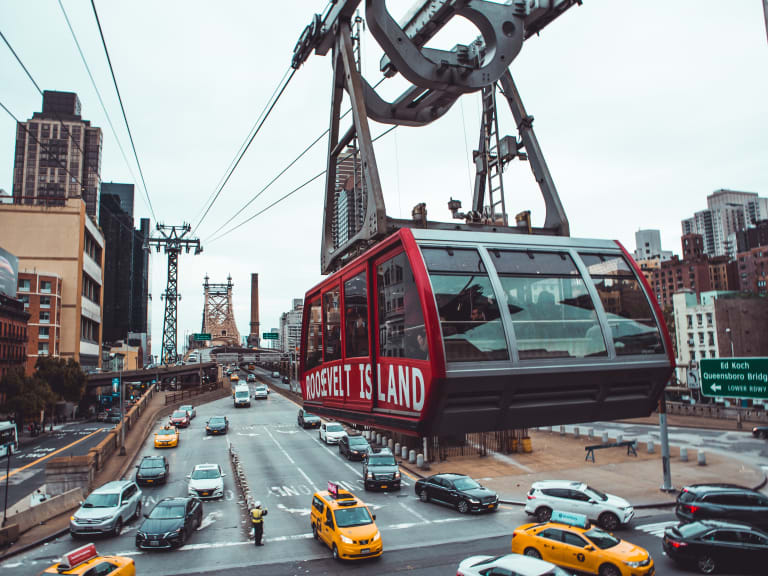
To ensure the safety and efficiency of the system, operators enforce several strict rules. Familiarizing yourself with these policies will prevent delays at the turnstile.
A common mistake made by first-time riders is assuming they can pay $2.90, ride to Roosevelt Island, stay on the cabin, and ride back to Manhattan for free. This is strictly prohibited. All passengers must exit the cabin at the terminal station.
Even if you immediately want to return, you must walk out through the exit gates, re-enter through the turnstiles, and pay a second $2.90 fare. This rule ensures accurate capacity counting and prevents tourists from monopolizing the cabins during busy commuter hours.
Each POMA cabin has a strict maximum capacity of 110 passengers. There are very few seats inside (primarily reserved for elderly or disabled passengers); the vast majority of riders must stand. A cabin attendant rides in every car and manually counts passengers. Once the 110-person limit is reached, the attendant will physically block the doors, and you will have to wait for the next cabin, regardless of whether your group is split up.
The tram is highly accessible, featuring large elevators at both the Manhattan and Roosevelt Island stations. However, there are specific rules for large items and animals:
Navigating to the tram stations is straightforward, but knowing the exact cross streets helps avoid confusion, especially in busy Midtown Manhattan.
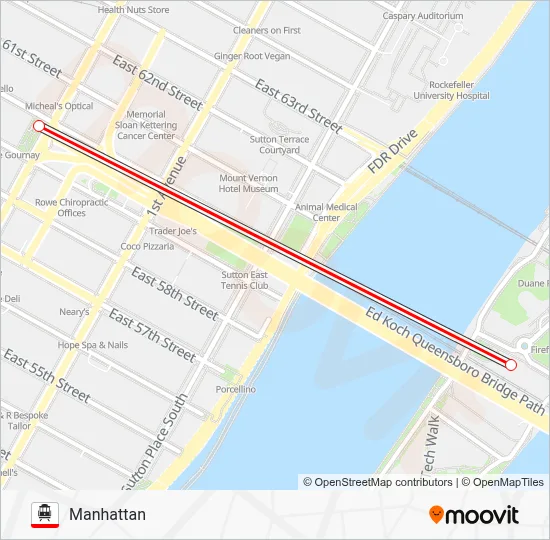
Location: Tramway Plaza, at the intersection of East 59th Street and Second Avenue.
Subway Connection: The closest subway hub is Lexington Av/59 St (4, 5, 6, N, R, W trains). Exit the station and walk two blocks east along 59th Street. The walk takes approximately 5 to 7 minutes.
Location: Tramway Plaza (Roosevelt Island), just north of the Ed Koch Queensboro Bridge.
Subway Connection: The Roosevelt Island F train station is located about a 5-minute walk north of the tram station. Simply follow the main pedestrian promenade along Main Street.
For detailed routing from your specific location, you can check real-time transit apps like Moovit's Roosevelt Island Tram schedule, which integrates the tram's timetable with connecting bus and subway routes.
The Roosevelt Island Tramway is a remarkable piece of urban infrastructure that offers a top-tier sightseeing experience for the price of a standard subway swipe. By understanding the schedule and utilizing modern payment methods, you can seamlessly integrate this aerial journey into your New York City itinerary.